

Fair Housing Laws in DC, Maryland & Virginia: What Every Homebuyer Should Know
/Equal Access to Housing Matters

Fair housing laws exist for a simple reason: every person deserves equal access to housing opportunities.
Whether someone is buying a home, renting an apartment, or applying for a mortgage, the law prohibits discrimination based on personal characteristics.
These protections apply to:
* buying a home
* renting housing
* mortgage lending
* real estate advertising
* brokerage services
For homebuyers in Washington, D.C., Maryland, and Northern Virginia, fair housing protections come from federal law, state law, and local civil rights statutes.
Since 1991, the Exclusive Buyer’s Agents of Buyer’s Edge | BuyersAgent.com has represented homebuyers exclusively, helping clients navigate the real estate market while ensuring equal access to housing opportunities and ethical representation throughout the buying process.
TL;DR Fair Housing Rules for Homebuyers
Fair housing laws make it illegal to discriminate when buying, selling, renting, financing, or advertising housing.
Federal law protects seven core classes. Washington, D.C., and Maryland add additional protections, while Virginia largely mirrors federal law but enforces it through state agencies.
Real estate professionals must provide equal access to housing opportunities and equal professional services to every buyer.
Policies that limit housing access, even unintentionally, can violate fair housing law.
The Fair Housing Act: The Foundation of Housing Rights
The Fair Housing Act of 1968 (42 U.S.C. §3601–3619) is the primary federal law prohibiting housing discrimination.
The law is enforced by the U.S. Department of Housing and Urban Development (HUD).
Federal law prohibits discrimination based on:
* Race
* Color
* Religion
* Sex
* National origin
* Disability
* Familial status
These protections apply to:
* home purchases
* rentals
* mortgage lending
* housing advertising
* real estate brokerage services
* property management
Housing decisions must be based on legitimate financial qualifications, not personal identity.
Source
U.S. Department of Housing and Urban Development
First-Time Home Buyer Guide in DC, Maryland, and Northern Virginia
What Is Housing Discrimination?
Housing discrimination occurs when a person is treated differently in the buying, renting, financing, or advertising of housing because of a protected characteristic such as race, religion, disability, or family status.
Discrimination may occur through:
* refusing to sell or rent a property
* offering different terms or conditions
* limiting access to housing opportunities
* discriminatory advertising
* unequal access to property showings
Housing discrimination can be intentional or unintentional. Policies that appear neutral, even though they disproportionately disadvantage protected groups, may also violate fair housing law.
How Fair Housing Laws Affect Homebuyers in DC, Maryland & Virginia
Fair housing laws directly affect how homes are marketed, shown, and sold throughout Washington, D.C., Maryland, and Northern Virginia.
For homebuyers, these protections help ensure:
Equal Access to Homes for Sale

All qualified buyers must have the opportunity to view available properties. Real estate professionals cannot limit access to homes based on protected characteristics.
Equal Treatment During Showings
Agents must apply the same showing policies and procedures to all buyers.
Fair Negotiation Opportunities
Sellers and real estate professionals cannot reject offers based on protected characteristics such as race, religion, disability, or family status.
Equal Access to Financing
Mortgage lenders must evaluate buyers based on financial qualifications, not personal characteristics.
Together, these protections help ensure that homebuyers compete in the housing market based on financial ability and qualifications, not personal identity.
Fair Housing Laws in Washington, D.C.
Washington, D.C., has some of the strongest housing discrimination protections in the United States under the DC Human Rights Act (D.C. Code §2-1402.21).
In addition to federal protections, Washington, D.C. prohibits discrimination based on:
* Age
* Marital status
* Personal appearance
* Sexual orientation
* Gender identity or expression
* Political affiliation
* Source of income
* Place of residence or business
* Family responsibilities
* Matriculation
These protections apply to home sales, rentals, mortgage lending, advertising, and real estate brokerage services throughout the District.
Sources
DC Office of Human Rights
DC Code §2-1402.21
Fair Housing Laws in Maryland
Understanding fair housing laws in Maryland real estate helps homebuyers recognize their rights and avoid discriminatory practices.
Maryland expands federal protections through the Maryland Fair Housing Act (Md. Code, State Government §20-702).
Maryland law prohibits housing discrimination based on federal classes, plus:
* Marital status
* Sexual orientation
* Gender identity
* Source of income
* Military status
The source-of-income protection is particularly important, because landlords cannot refuse housing simply because a tenant uses lawful income sources such as:
* Housing Choice Vouchers
* Social Security income
* Disability income
* Child support
* Other lawful income sources
Sources
Maryland Code §20-702
Maryland Commission on Civil Rights
Fair Housing Laws in Virginia
Virginia enforces fair housing protections through the Virginia Fair Housing Law (Virginia Code §36-96.3).
Virginia prohibits housing discrimination based on:
* Race
* Color
* Religion
* National origin
* Sex
* Familial status
* Disability
Virginia law closely mirrors federal protections but provides state-level enforcement through the Virginia Fair Housing Office.
Consumers in Northern Virginia may file complaints through either HUD or the Virginia Fair Housing Office.
Sources
Virginia Code §36-96.3
Virginia Fair Housing Office
Quick Comparison of Fair Housing Protections
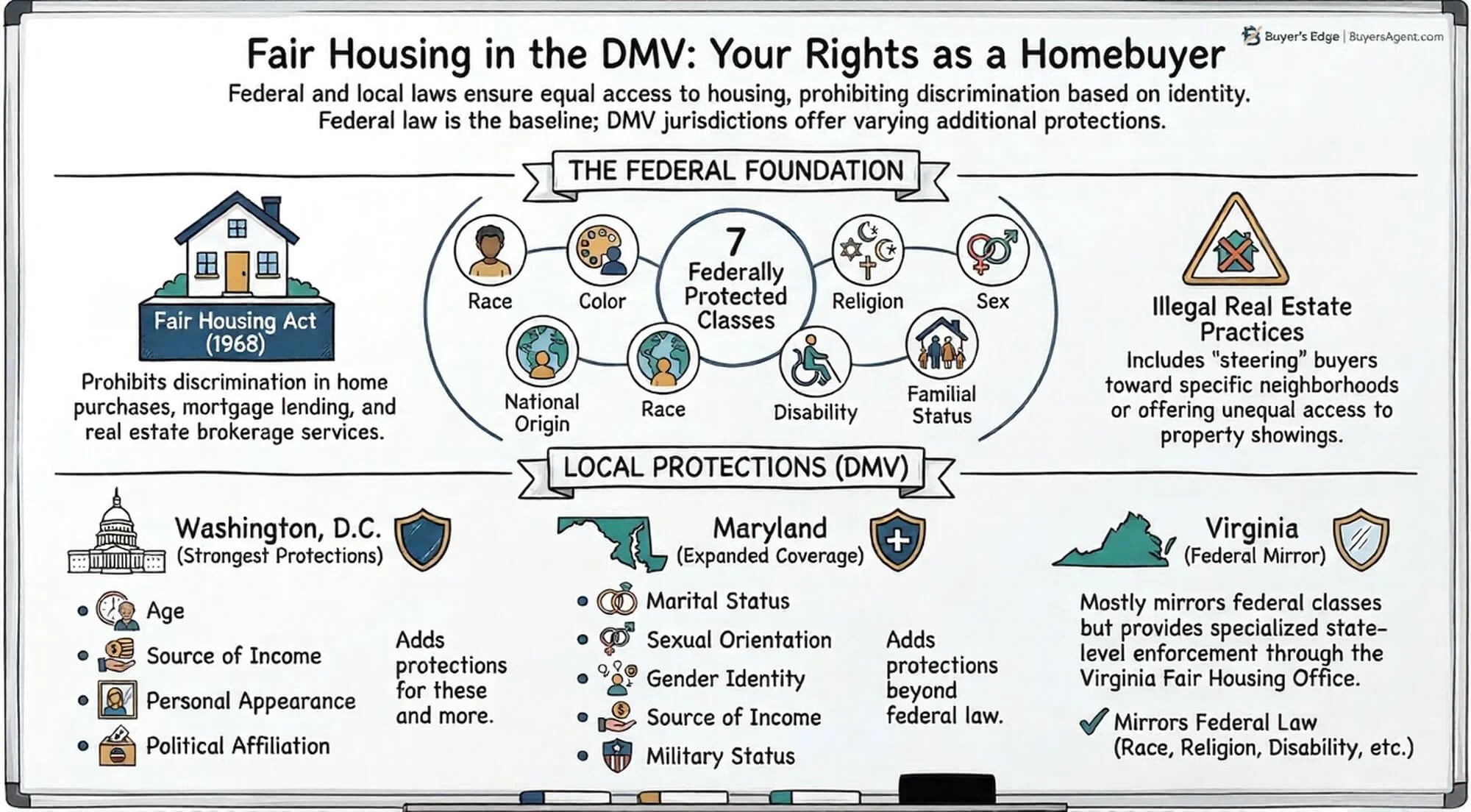
Housing discrimination laws in DC, Maryland, and Virginia work alongside federal fair housing protections to ensure equal access to housing opportunities.
Jurisdiction Additional Protected Classes Beyond Federal Law
Washington, D.C. Age, marital status, personal appearance, sexual orientation, gender identity, political affiliation, source of income, place of residence/business, family responsibilities, matriculation
Maryland Marital status, sexual orientation, gender identity, source of income, military status
Virginia Generally mirrors federal protected classes
The infographic below summarizes the federal Fair Housing Act and the additional housing discrimination protections in Washington, D.C., Maryland, and Virginia.
Examples of Fair Housing Violations in Real Estate
Housing discrimination is not always obvious. Many violations occur through everyday real estate practices.
Examples of housing discrimination in real estate:
Steering Buyers Toward Certain Neighborhoods
Steering occurs when a real estate professional guides buyers toward or away from neighborhoods based on protected characteristics.
Discriminatory Advertising
Housing advertisements cannot express preferences based on protected characteristics.
Examples may include phrases such as:
* “Perfect for young professionals.”
* “Ideal for singles.”
* “No children.”
Advertising must focus on property features, not the characteristics of potential buyers.
Unequal Showing Practices
Every qualified buyer must have equal access to housing opportunities.
Examples may include:
* offering showings to some buyers but not others
* delaying appointments for certain buyers
* providing different levels of property information
Following Discriminatory Instructions
Real estate agents cannot comply with discriminatory requests from sellers or landlords. Participating in discrimination, even when directed by a client, is illegal.
Policies That Create Disparate Impact
Fair housing violations may occur when policies appear neutral, although they disproportionately affect protected groups.
The U.S. Supreme Court confirmed this doctrine in Texas Department of Housing and Community Affairs v. Inclusive Communities Project (2015).
Fair Housing and Today’s Housing Market
Fair housing law was written decades before online real estate marketplaces existed, but the underlying principle remains the same: housing opportunities should be accessible to everyone.
Housing opportunities should be accessible to everyone.
When homes are widely marketed and available to the public, buyers have a fair opportunity to compete based on their qualifications.
Housing advocates commonly emphasize that transparent, widely marketed housing inventory promotes equal access to housing opportunities.
Common Fair Housing Questions Homebuyers Ask
Understanding fair housing rules for homebuyers can help buyers recognize when housing practices may violate the law.
What is the Fair Housing Act?
The Fair Housing Act of 1968 prohibits discrimination in housing based on race, color, religion, sex, national origin, disability, and familial status.
Do fair housing laws apply when buying a home?
Yes. Fair housing laws apply to home purchases, rentals, mortgage lending, and real estate services.
Is steering illegal in real estate?
Yes. Steering buyers toward or away from neighborhoods based on protected characteristics violates fair housing law.
Can a seller reject an offer because of race or family status?
No. Housing discrimination based on protected classes is illegal under federal and state fair housing laws.
What is disparate impact?
Disparate impact occurs when a policy that appears neutral disproportionately harms a protected group.
Buyer’s Edge Commitment to Fair Housing in Washington DC, Maryland,
and Northern Virginia.
Since 1991, Buyer’s Edge | BuyersAgent.com has represented homebuyers exclusively through a true exclusive buyer agency agreement, ensuring our agents work only for the buyer and never represent sellers in the same transaction.
Our structure eliminates many conflicts of interest common in traditional brokerage models.
Buyer’s Edge agents:
* represent homebuyers only
* never list homes
* never represent sellers
* never practice dual agency
Because we work exclusively for buyers, we are committed to equal access to housing, ethical representation, and transparency throughout the home buying process.
Fair housing is not simply a legal obligation; it is central to our mission of protecting homebuyers.
Sources
U.S. Department of Housing and Urban Development
Maryland Commission on Civil Rights
Virginia Fair Housing Office
DC Office of Human Rights
Related:
How the $1.6 B Compass–Anywhere Merger Reshapes the U.S. Real Estate Landscape
Disadvantages of “Pocket Listings” or “Off-MLS” for Home Sellers and Buyers
What is an Exclusive Buyer's Agent: The Real Estate Game-Changer
Every Homebuyer Needs to Know in the Washington, DC Metro Area
How to Find Expert Buyer's Agent Services in the DMV
Best Home Buying Checklist – Steps to Buying a House in DC, MD, VA
Work with Experienced Buyer’s Agents Who Have Access to Both On-Market and Off-Market Homes.

